
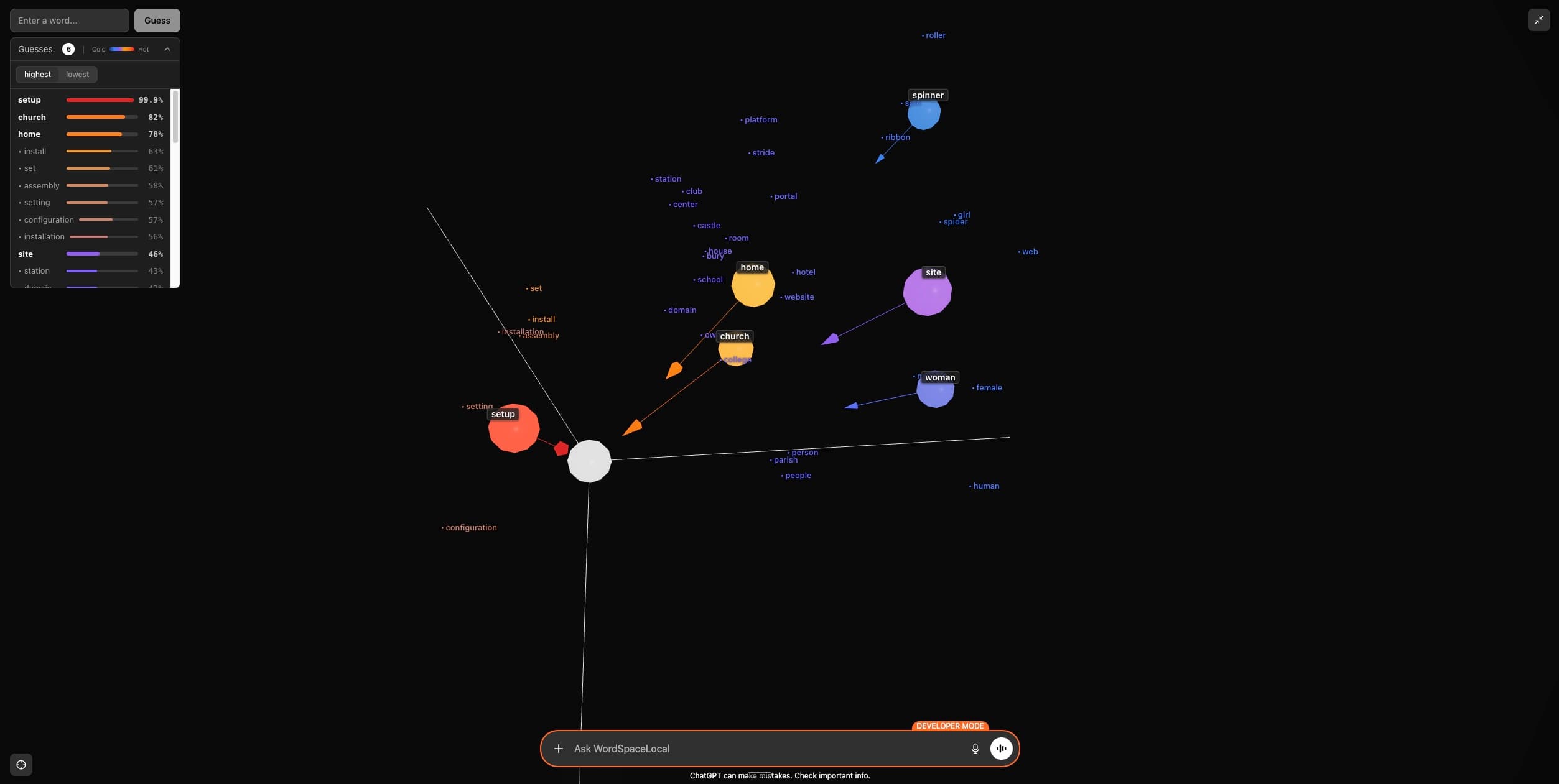

It's like Wordle, but in space.
WordSpace is a word-guessing game where you find a hidden word by exploring semantic space — a 3D map of how AI understands meaning. Words that keep similar company sit close together. Words with nothing in common live far apart. You guess words and watch where they land.
You can play in ChatGPT. Use the button above to get started.
How It Works
"You shall know a word by the company it keeps." — J.R. Firth, 1957
When a machine reads billions of sentences, it discovers that words have positions — not on a page, but in a space of meaning. "Happy" sits near "joyful." "Cat" neighbors "dog." "Ocean" and "sea" are almost touching. Nobody programmed this. The machine figured it out by learning which words keep company together, and translating those patterns into numbers.
Each word gets 512 numbers, or, 512 dimensions: its coordinates in semantic space. We compress those down to 3 dimensions so you can see them. Think of it like making a flat map of a round Earth: some distortion is inevitable, but the neighborhoods stay intact.
The Score
The similarity score is your true compass. It measures distance in the full 512-dimensional space, before any compression. Blue means cold. Red means hot. Follow the heat.
When the 3D positions seem to disagree with the score, trust the score — it's measuring in the space you can't see.
Your AI Assistant
ChatGPT sees the same 3D map you do — every guess, every position, every score. It can reason about semantic neighborhoods, notice that your guesses are clustering in one family, and suggest exploring a different one.
This isn't cheating. It's the game.
You bring human intuition about word meaning. ChatGPT brings its map of the full 512-dimensional space. The 3D visualization is where those two perspectives meet — a shared representation that both human and AI can reason about.
What You'll Discover
This is the map AI uses when it reads. Every chatbot, every search engine, every translation system navigates a space like this one.
You'll notice that words cluster into families with resemblances — animals in one neighborhood, emotions in another, tools in a third. But the boundaries are fuzzy. "Bat" sits with mammals and reaches toward "baseball." And here's something that surprises everyone: antonyms are neighbors. "Hot" and "cold" sit close together because they appear in nearly identical sentences. They keep the same company.
Playing WordSpace won't teach you everything about how AI works. But it will give you a feel for the geometry underneath — something most people never see.